
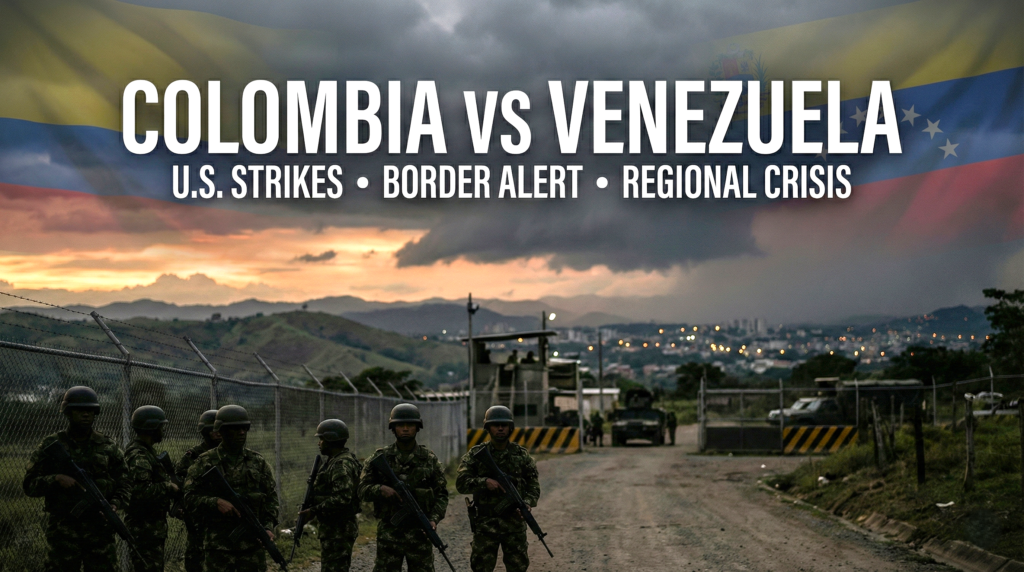
In the early hours of January 3, 2026, the United States launched a large-scale military strike on Venezuela that targeted key military sites, including in and around Caracas, and resulted in the reported capture of Venezuelan President Nicolás Maduro and his wife, Cilia Flores. The dramatic escalation dramatically shifted the Colombia vs Venezuela dynamic, raising fears of a wider regional crisis, a humanitarian emergency on the shared border, and intense diplomatic backlash worldwide.
The strikes, announced by former U.S. President Donald Trump on social media and cited by multiple international outlets, mark the most direct American military intervention in Latin America since the 1989 invasion of Panama. Trump claimed special operations forces, including Delta Force, conducted the operation swiftly before dawn and that Maduro and Flores were flown out of Venezuela and into U.S. custody to face criminal charges. the-journal.com+1
Border Reinforcement and Humanitarian Preparations
Colombia’s President Gustavo Petro ordered military forces to the border with Venezuela and placed the frontier under maximum alert amid fears of mass civilian displacement. Petro also convened Colombia’s National Security Council and prepared humanitarian assistance for a potential refugee influx. The Colombian government has urged international bodies, including the United Nations Security Council, to debate the legality and consequences of the U.S. action.
Humanitarian concerns are heightened by historical precedent: during past crises — notably the 2015 Colombia–Venezuela migrant crisis — border closures and mass migration created prolonged hardship for families and local economies.
Venezuelan Government Response and Global Reactions
The Venezuelan government rejected the U.S. strikes as “military aggression,” declaring a national emergency and demanding proof of life for the detained leaders. Vice President Delcy Rodríguez, with President Maduro’s whereabouts uncertain, called for international solidarity and condemned what Caracas described as an illegal infringement on sovereignty.
International reaction has been sharply divided. UN Secretary-General António Guterres warned the U.S. action set a “dangerous precedent” in international affairs, emphasizing respect for sovereignty under the UN Charter. Many Latin American governments, including Brazil and Mexico, condemned the intervention as unlawful, while some leaders elsewhere stressed the need for diplomatic restraint.
Legal and Diplomatic Implications
U.S. officials framed the operation partly as a law enforcement action, citing longstanding U.S. criminal charges against Maduro related to alleged drug trafficking conspiracies. However, questions remain about legal authority for military strikes without broad international mandate, and whether this intervention will stabilize or further destabilize Venezuela and the region.
Official U.S. statements and wider legal frameworks can be reviewed via the U.S. Department of State and the United Nations Charter for context on sovereignty and use of force:
- U.S. Department of State – Venezuela Policy: https://www.state.gov/venezuela/
- United Nations Charter (on Use of Force and Sovereignty): https://www.un.org/en/about-us/un-charter
What Happens Next
The situation remains fluid. Colombia faces mounting pressure to manage border security and humanitarian relief, while Venezuela confronts internal power uncertainty. Diplomatic efforts — including emergency discussions at the UN Security Council — are expected. How regional alliances realign and whether the U.S. will anchor a transition government or withdraw influence will shape the future trajectory of Colombia vs. Venezuela relations.