
Hidden VA Benefits Veterans Can Still Claim in 2026
Many veterans know the basics: the GI Bill, VA health care, and VA-backed home loans. But a growing number of families are learning that some of the most financially meaningful programs are not the most visible ones. Those hidden VA benefits can mean the difference between just getting by and finally receiving the support a veteran or surviving spouse actually earned.
That matters now because benefit complexity—not just eligibility—has become one of the biggest barriers facing former service members. In practice, many veterans miss payments or support simply because they never realize a benefit exists, or they assume they do not qualify. Official guidance from the U.S. Department of Veterans Affairs shows several programs can add monthly income, pay for home or vehicle modifications, replace damaged clothing, support burial planning, and help disabled veterans return to work.
For veterans navigating disability ratings, aging-related care, mobility limits, PTSD, traumatic brain injury, or survivor planning, these hidden VA benefits are increasingly important—and in some cases, time-sensitive.
READ MORE: 2026 VA Benefits Cost of Living Update: New Proposal Could Lower Health Care Costs for Millions of Veterans
Why Hidden VA Benefits Are Getting More Attention
The reason this issue keeps resurfacing is simple: many VA programs are layered on top of each other. A veteran may already receive disability compensation or pension and still qualify for an additional payment, grant, or service.
That is especially true for older veterans, disabled veterans, and families caring for someone with reduced mobility or cognitive decline. A veteran who assumes, “I already have my VA benefits,” may still be missing several hidden VA benefits tied to functional limitations, transportation, prosthetics, housing, or family circumstances.
The practical problem is that many of these programs are not marketed like mainstream VA benefits. They often require a specific medical form, a disability code, a secondary claim, or proof that a condition is service-connected. That administrative friction is exactly why the phrase hidden VA benefits resonates with veterans searching for help.
The Most Overlooked Hidden VA Benefits Veterans Should Check Now
1) Aid and Attendance or Housebound Benefits
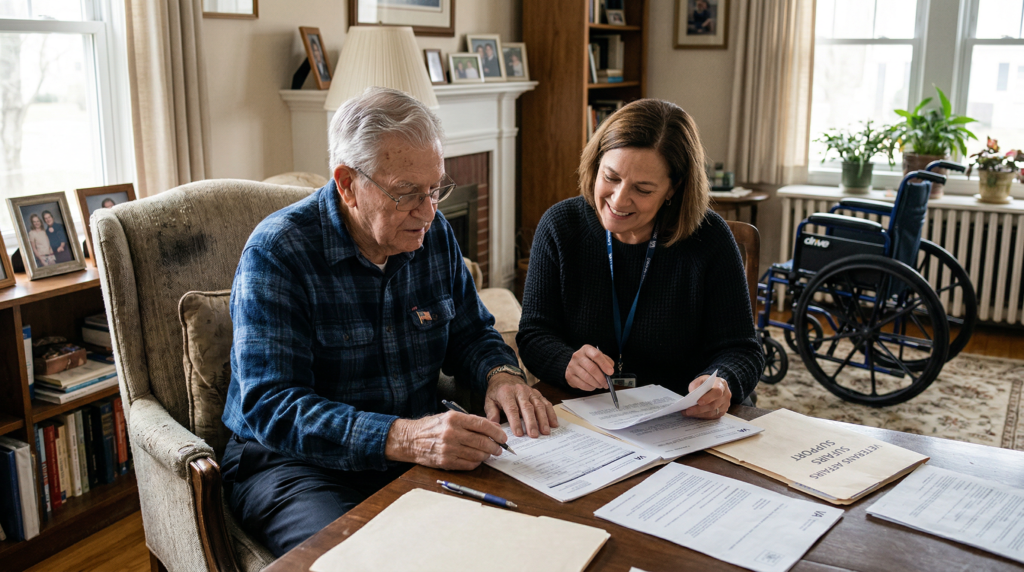
One of the most valuable hidden VA benefits is Aid and Attendance or Housebound benefits.
According to the VA, this is an extra monthly payment available to eligible veterans or survivors who already qualify for a VA pension and need help with daily living activities such as bathing, dressing, feeding, or supervision. It may also apply to someone who is mostly confined to their home or living in a nursing facility.
Why this matters: families often spend months or years paying out of pocket for home assistance before realizing this program exists. Among all hidden VA benefits, this is one of the most financially important for aging wartime veterans and surviving spouses.
Who often misses it
- Older veterans who need regular help at home
- Surviving spouses caring for medical needs
- Families paying for assisted living or in-home support
- Veterans who mistakenly think “pension” means they are not eligible to ask for more
2) Special Monthly Compensation (SMC)
If standard disability compensation is what most veterans know, Special Monthly Compensation (SMC) is one of the most misunderstood hidden VA benefits.
SMC pays above the regular disability schedule when a veteran has certain severe service-connected disabilities or combinations of impairments. This can apply to veterans with loss of use of limbs, blindness, severe sensory loss, the need for daily aid and attendance, or housebound status due to service-connected conditions.
In plain terms, SMC exists because some disabilities create needs that go beyond a percentage rating.
Why veterans miss SMC
- They assume a 100% rating already includes everything
- They never connect mobility loss or caregiver dependence to a separate benefit
- They are not told that multiple conditions can trigger SMC review
- They do not realize some SMC categories are automatically raised by evidence already in the file
For many families, SMC is the textbook example of hidden VA benefits because it can significantly increase monthly income but often requires very specific evidence.
3) Specially Adapted Housing (SAH) and Home Modification Grants

Housing adaptation remains one of the most practical hidden VA benefits available to veterans with serious service-connected disabilities.
The VA offers Specially Adapted Housing (SAH) grants and related housing support programs that can help eligible veterans buy, build, or modify a home to accommodate disabilities. These grants are intended to improve independent living—such as widening doorways, adding ramps, making bathrooms wheelchair-accessible, or adjusting floor plans for mobility devices.
This is where many families get stuck: they think the VA only helps with mortgages, not structural accessibility.
That is wrong. For veterans with amputations, paralysis, severe burns, blindness, or major mobility impairment, these hidden VA benefits can dramatically reduce long-term care strain and make it possible to stay at home longer.
Common real-life uses
- Roll-in showers
- Stair lifts or ramps
- Wheelchair-accessible kitchens
- Wider hallways and door frames
- Bathroom safety upgrades
For disabled veterans trying to age in place, this is often more important than a home loan benefit.
4) Automobile Allowance and Adaptive Equipment
Another highly overlooked category of hidden VA benefits is automobile allowance and adaptive equipment.
Some veterans with service-connected disabilities may qualify for financial help to buy or modify a vehicle if their condition affects driving or transportation. That can include loss of use of hands or feet, severe vision impairment, ALS, severe burns, or certain joint immobility conditions.
The benefit may cover a specially equipped vehicle or adaptive equipment such as:
- power steering
- power seats
- hand controls
- lift systems
- access equipment for entering and exiting a vehicle
This is one of those hidden VA benefits that families often discover only after paying for modifications themselves.
5) Annual Clothing Allowance
This may sound minor compared with housing or compensation, but the VA clothing allowance is one of the most practical hidden VA benefits veterans overlook every year.
Eligible veterans may receive an annual payment if a prosthetic or orthopedic device damages clothing, or if medication for a service-connected skin condition permanently damages outer garments. Some veterans may qualify for more than one annual payment depending on how many devices or medications affect their clothing.
This matters because many veterans live with wheelchairs, braces, prosthetics, or topical treatments that create repeated replacement costs. Over time, that expense adds up.
Among all hidden VA benefits, this is one of the easiest to dismiss—and one of the easiest to miss.
6) Veteran Readiness and Employment (VR&E)
For veterans trying to rebuild work life after injury or illness, Veteran Readiness and Employment (VR&E) remains one of the most misunderstood hidden VA benefits.
Often still referred to by older veterans as “Chapter 31,” the program helps eligible veterans with service-connected disabilities prepare for, find, and keep suitable employment. Depending on the case, it may also support education, training, counseling, resume development, accommodations, and in some circumstances independent living services.
This benefit is often overlooked because many veterans assume:
- it is only for college
- it duplicates the GI Bill
- it is only for recently separated service members
That is not how the program actually functions. VR&E is one of the more adaptive hidden VA benefits, because it is built around employment barriers caused by disability—not just classroom enrollment.
7) Burial and Memorial Benefits
Burial planning is often delayed until a crisis, which is exactly why these hidden VA benefits are so often missed.
The VA confirms that eligible veterans—and in some cases spouses and dependents—may qualify for burial and memorial benefits, including a gravesite in a national cemetery, a government headstone or marker, a burial flag, a Presidential Memorial Certificate, and in some situations burial allowances or transportation reimbursement.
Families are often surprised to learn two things:
- Some planning can be done in advance
- Some benefits may still apply even if burial is not in a VA cemetery
That makes this one of the most emotionally important hidden VA benefits for spouses and adult children managing future arrangements.
8) VA Life Insurance and Survivor Protection
Insurance is another area where hidden VA benefits often go underused.
VA life insurance programs are designed for specific groups of veterans and service members, including some disabled veterans and transitioning service members. Families can review current options through the official VA life insurance portal.
Eligibility, deadlines, and policy options vary by program, which is why many families assume they have “missed their window” when they may still qualify for a current or replacement option.
This is one of the most important hidden VA benefits for households trying to balance disability, aging, and estate planning.
READ MORE: IRS Tax Refund April 2026: What Taxpayers Need to Know About Refunds, Direct Deposit, and Delays
Why Disability Ratings Often Determine Access
If there is one theme running through nearly every category of hidden VA benefits, it is this: your service-connected rating and medical evidence shape what else becomes available.
A veteran might think they are only applying for:
- a rating increase
- TDIU
- a secondary condition
- caregiver documentation
- a mobility device
But that same evidence could also support:
- SMC
- clothing allowance
- housing adaptation
- automobile equipment
- home-based assistance
- survivor or burial planning
That is why veterans’ advocates often urge people to review not just their rating percentage, but the functional impact described in their records.
The question is not only, “What is my rating?”
It is also, “What does the VA now recognize that I cannot safely do on my own?”
That is where many hidden VA benefits begin.
How Surviving Spouses and Caregivers Miss Out Too
A major blind spot in veterans coverage is how often benefits are missed by the family, not the veteran.
Spouses and caregivers frequently assume they are “not the veteran,” so they do not pursue:
- pension-related survivor support
- burial pre-need eligibility
- memorial benefits
- reimbursement claims
- dependent-related benefit add-ons
That misunderstanding leaves money and support on the table.
Some of the most overlooked hidden VA benefits are never claimed because the veteran dies before the family knows what records to gather or what applications to file.
Families should also review VA family and caregiver benefits if they are providing daily assistance or navigating long-term support needs.
What Veterans Should Do Before Filing

If you think you may qualify for one or more hidden VA benefits, the smartest next move is not to guess. It is to document.
Gather these first
- DD-214 or discharge papers
- Current VA rating decision letters
- Recent medical records
- Functional limitation notes (walking, bathing, dressing, transportation, cognition)
- Caregiver statements, if applicable
- Prosthetic, brace, wheelchair, or medication documentation
- Funeral or burial paperwork, if filing after a death
Best next steps
- Review the official VA benefits portal
- Check pension add-ons through Aid and Attendance / Housebound
- Review SMC payment categories
- Explore burial and memorial benefits
- Look at housing adaptation grants
- Use an accredited Veterans Service Organization or VA-accredited representative if the claim is complex
For veterans and families, the biggest mistake is waiting until a crisis makes the paperwork harder.
What Happens Next
Expect this issue to keep growing in relevance as more aging veterans enter periods of increased medical and caregiving need.
The policy landscape around veterans’ benefits is not just about adding new programs. In many cases, the more urgent challenge is helping veterans access benefits that already exist but remain buried in the claims system.
That is why hidden VA benefits matter so much right now. They are not fringe perks. For many households, they are the support system standing between financial strain and stability.
The veterans who benefit most are often not those with the most information. They are the ones who know where to look—and who understand that a rating decision is often the start of a benefits conversation, not the end of one.
FAQ: Hidden VA Benefits Veterans Are Searching For
1) What are the most hidden VA benefits in 2026?
The most overlooked hidden VA benefits include Aid and Attendance, Housebound benefits, Special Monthly Compensation (SMC), housing adaptation grants, annual clothing allowance, adaptive vehicle grants, VR&E, burial assistance, and some VA life insurance options.
2) Can I get hidden VA benefits even if I already receive disability compensation?
Yes. Many hidden VA benefits are layered on top of standard compensation. A veteran receiving a regular disability payment may still qualify for SMC, clothing allowance, adaptive equipment, housing grants, or transportation-related help depending on the service-connected condition and evidence.
3) Is Aid and Attendance only for nursing homes?
No. That is one of the biggest misconceptions around hidden VA benefits. Aid and Attendance may also apply to eligible veterans or survivors who need help with everyday activities at home, not just those living in institutions.
4) How do I know if I should ask about Special Monthly Compensation?
If you have severe service-connected limitations involving mobility, vision, loss of use of limbs, or regular dependence on another person for daily care, you should ask whether your evidence supports SMC.
5) Are surviving spouses eligible for hidden VA benefits too?
Often, yes. Some hidden VA benefits extend to surviving spouses or family members through pension-related support, burial and memorial benefits, and other dependent or survivor programs.
6) How many public vocational schools Charlottesville VA?
If you mean a dedicated public vocational/technical center serving Charlottesville, the main shared public technical center is Charlottesville-Albemarle Technical Education Center (CATEC), which serves Charlottesville City and Albemarle County students and also offers adult programs.
7) Can the VA help pay for a wheelchair ramp or accessible bathroom?
Possibly, yes. Housing adaptation grants are among the most useful hidden VA benefits for veterans with serious service-connected disabilities.
8) What is the easiest hidden VA benefit to miss?
One of the easiest hidden VA benefits to miss is the annual clothing allowance. Veterans using braces, prosthetics, wheelchairs, or certain medications often do not realize they may qualify for yearly payments to replace damaged clothing.
Conclusion
Veterans are often told to “apply for what you earned,” but that advice only works if they know what exists.
The reality is that some of the most valuable hidden VA benefits are not hidden because they are secret. They are hidden because the system is complicated, paperwork-heavy, and often reactive instead of proactive.
That leaves many veterans and families one form, one doctor’s note, or one overlooked eligibility rule away from support they should already have.
For a lot of households in 2026, the smartest benefits move is not finding something new. It is uncovering what was already there.


