USS Gerald R. Ford NATO Tensions: 7 Alarming Facts About the World’s Most Powerful Warship’s Record-Breaking 2026 Deployment
USS Gerald R. Ford NATO tensions have reached a level not seen in decades as America’s largest and most technologically advanced aircraft carrier navigates an unprecedented 11-month global deployment spanning the Arctic, Europe, the Caribbean, and the Middle East. What began as a routine European mission in June 2025 has transformed into one of the most consequential naval deployments since the Vietnam War, placing the USS Gerald R. Ford (CVN-78) at the absolute center of global geopolitics.
This is the inside story of how a single $13 billion warship became the most important military asset on the planet.
The Ship That Rewrote the Rules of Naval Power
Commissioned on July 22, 2017, by President Donald Trump himself at Naval Station Norfolk in Virginia, the USS Gerald R. Ford is the lead ship of its class and the largest warship ever constructed. Displacing approximately 100,000 tons and stretching 1,106 feet in length, the nuclear-powered carrier is built around two next-generation A1B nuclear reactors that give it a range of roughly 25 years before needing a mid-life refuel.
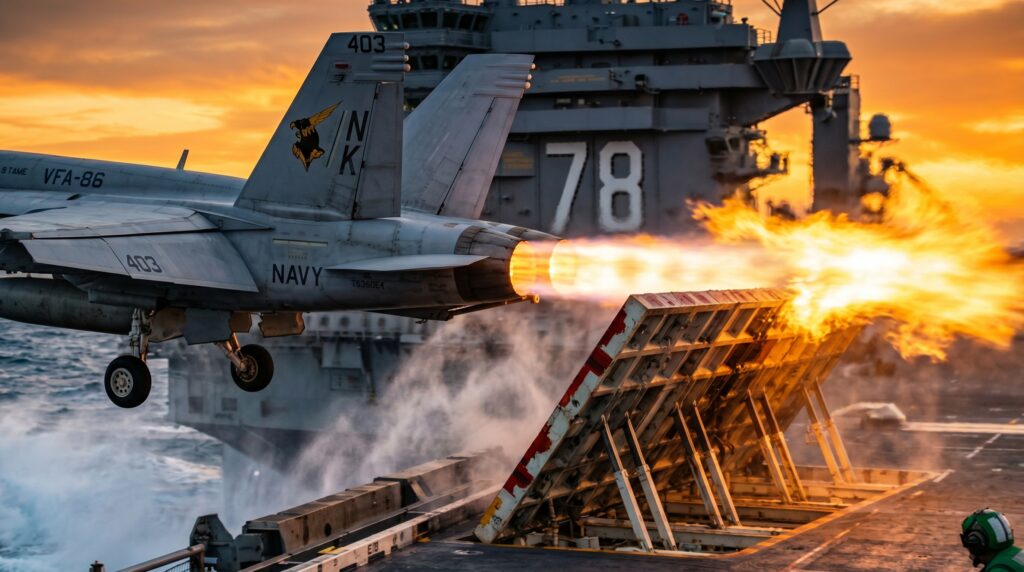
The ship carries more than 75 aircraft, has a crew complement of approximately 4,539 including its air wing, and features the revolutionary Electromagnetic Aircraft Launch System, or EALS, which replaces older steam catapults. No other carrier in the American fleet can launch more aircraft faster. That technological edge has made the Ford irreplaceable in the current moment of global instability.
READ MORE: 7 Alarming Facts About China Sending Weapons to Iran Amid a Fragile Ceasefire
How USS Gerald R. Ford NATO Tensions Exploded in the Arctic
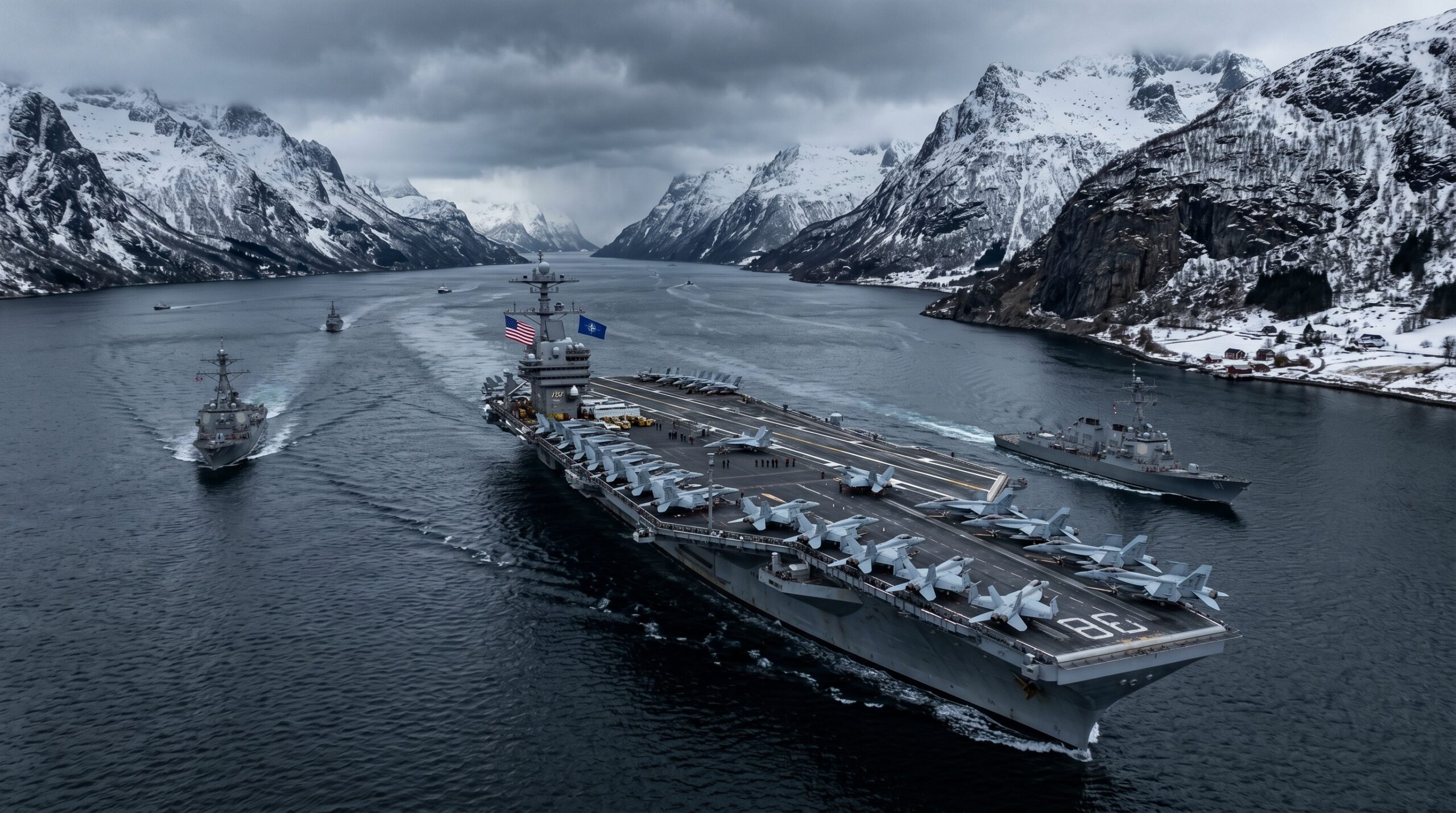
The current deployment began on June 24, 2025, when the Ford departed Norfolk, Virginia, and headed toward European waters. What followed was extraordinary. Between August 23 and September 8, 2025, the Ford Carrier Strike Group executed operations at extreme latitudes near Norway’s Svalbard archipelago, marking the farthest north a U.S. carrier had operated in decades. Fully integrated under NATO’s Allied Maritime Command (MARCOM), the strike group conducted joint operations alongside warships from Norway, Germany, and France.
The mission showcased NATO’s capacity to control the so-called “Bear Gap,” the critical maritime corridor between the Barents and Norwegian Seas through which Russia’s Northern Fleet submarines must transit to access the Atlantic Ocean. By sending its most advanced carrier into those waters, the United States sent an unmistakable strategic signal to Moscow.
USS Gerald R. Ford NATO tensions with Russia escalated further in late September 2025 when the carrier sailed into Norway’s Oslofjord on September 28 as part of NATO’s Neptune Strike 25-3 exercise. According to NBC News reporters embedded on the ship, F/A-18 fighter jets were launching continuously for assignments in Eastern Europe as Russian aircraft repeatedly violated the airspace of NATO member states.
“Several of those aircraft are going a long distance to drop live weapons on a close air support range that is to the northeast of here,” the Ford Carrier Strike Group commander told reporters aboard the ship. Estonia had already invoked Article 4 of the NATO charter, requesting urgent consultations after Russia violated its airspace with three MiG-31 fighter aircraft. Russian drones had also entered Polish airspace, and German Defense Minister Boris Pistorius confirmed Russian jets flew dangerously close to a German frigate operating in the Baltic Sea.
Neptune Strike 25-3 was not simply a drill. It was a live response to an escalating threat. The exercise involved 10,000 service members from 13 allied nations and spanned the Mediterranean, Adriatic, North, and Baltic Seas, with the Ford operating under direct NATO command in the North Sea. Norwegian Minister of Defence Bjørn Arild Gram called the carrier’s visit “a clear expression of the security guarantees we have through NATO.”
READ MORE: Strait of Hormuz Closed: 7 Critical Facts Rocking the Global Economy as Trump’s Deadline Expires
The Pivot to Venezuela and the Middle East
After completing its role in bolstering USS Gerald R. Ford NATO tensions against Russian aggression, the carrier transited the Strait of Gibraltar in late October 2025 and entered the Caribbean Sea as part of Operation Southern Spear. This marked one of the largest U.S. military buildups in the Caribbean in decades. On January 3, 2026, the Ford’s warplanes participated in the operation in Caracas that resulted in the capture of Venezuelan President Nicolás Maduro, a stunning use of carrier air power in the Western Hemisphere.
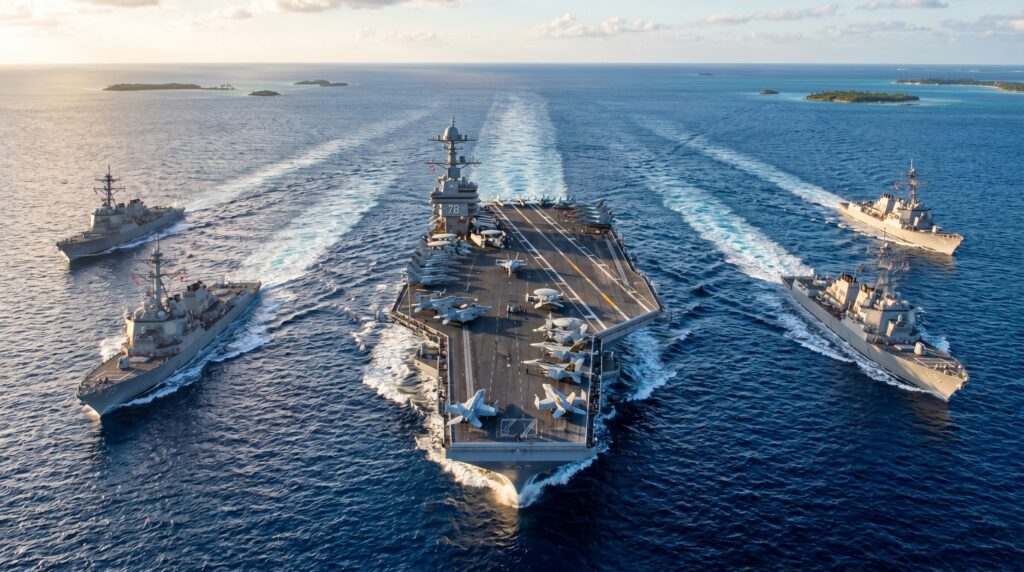
By February 2026, the USS Gerald R. Ford NATO deployment in Europe had given way to a new crisis. With Iran-U.S. tensions spiraling, the Navy redirected the Ford toward the Middle East. Tracking data confirmed the carrier transited eastward through the Strait of Gibraltar on February 20, 2026, before stopping at the NATO strategic base at Souda Bay in Crete, Greece, on February 23. On February 26, it departed Crete toward Israel’s coastline to reinforce American deterrence as diplomats and military commanders held their breath.
By parking the Ford at Souda Bay before its eastern transit, Washington sent both Tehran and Europe an unmistakable message. Gulf News captured it succinctly: “America is ready.”
A Record-Breaking Deployment Under Fire
The scale of the ongoing deployment has placed the USS Gerald R. Ford at the center of unprecedented operational strain. In mid-March 2026, a fire tore through the ship’s laundry department while it operated in the eastern Mediterranean. It took the crew 30 hours to contain and extinguish the blaze, according to CNN’s reporting, and roughly 600 sailors temporarily lost access to their bunks.
Two days after the fire, the carrier resumed flying sorties. It then sailed to Greece for repairs before an additional stop in Croatia, after which it returned to sea in time for President Trump’s threatened day of infrastructure strikes against Iran.
According to U.S. Naval Institute News, the deployment is on track to break the non-pandemic modern record for longest carrier deployment since Vietnam. That record belongs to USS Midway, which completed a 327-day deployment in March 1973. The Ford is projected to reach approximately 330 to 335 days at sea, placing it among the longest carrier deployments in U.S. history.
Admiral James Kilby, speaking before Congress, confirmed the deployment extension and described the Ford as “a great example of the flexibility of the Navy,” noting it had operated successively in the High North, the eastern Mediterranean, the Caribbean, and back again to the Mediterranean under U.S. Central Command.
The Human Cost and the Battle for Retention
The weight of the deployment extends far beyond operational statistics. For the approximately 4,500 sailors aboard, and for their families at home, it has been a year of relentless uncertainty.
“It’s constant uncertainty that we live on a daily basis,” said Amini Osias, whose daughter serves as an aviation electrician on the Ford. “I can hardly sleep.” When Iran shot down a U.S. fighter jet during combat operations in April 2026, Osias said the reality hit hard. “That could have been my daughter if she would have joined the Air Force.”
Retired Adm. James Stavridis, former Supreme Allied Commander at NATO, told CNN he would “expect challenges for the crew” given the deployment’s length, noting that Navy analysis consistently shows retention and morale issues accelerate once a ship exceeds six months away from home.
Defense Secretary Pete Hegseth has already ordered a review of attrition rates among Navy Strike Fighter Squadrons. The Navy is responding by offering flight officers and naval aviators tens of thousands of dollars annually in bonuses to stem the outflow of talent.
One bright spot aboard the Ford is Sage, a female Labrador retriever who serves as a therapy dog through the nonprofit Mutts with a Mission. Holding the rank of captain, Sage has been assigned to the carrier since 2023. She is “trained to alert to anxiety, reduce stress, and interrupt detrimental behaviors,” according to Tara Fisher, a spokesperson for the organization. Her skills are in especially high demand as the crew processes months of intense combat operations.
What USS Gerald R. Ford NATO Tensions Mean for the Future
The broader implications of the Ford’s deployment go beyond current conflicts. Analysts warn that the Navy’s heavy reliance on the Ford raises serious questions about readiness for a potential future conflict in the Pacific, where China represents the most significant long-term strategic challenge.
“If we didn’t have the Ford, we would be struggling to maintain an operational presence,” said Brent Sadler, a 26-year Navy veteran and former submarine officer, speaking to CNN. The ship’s unique electronic catapult system allows it to launch everything from small drones to the largest aircraft in the fleet, an advantage none of the other 10 U.S. nuclear-powered carriers currently share.
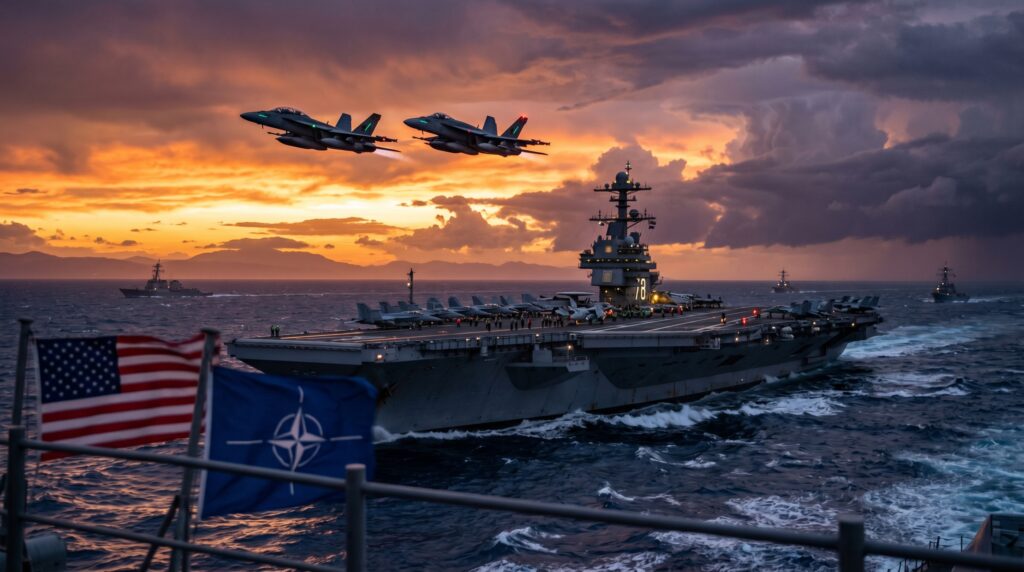
For NATO allies, the Ford’s presence throughout its European deployment has provided both tangible military capability and powerful political symbolism. Its deployment into Arctic waters, into the Norwegian fjords, and across the Mediterranean under NATO command has reinforced alliance cohesion at a moment when Europe’s security architecture faces its most serious stress test since the Cold War.
USS Gerald R. Ford NATO tensions are not simply a story about one ship. They are a story about the weight America places on its military power as the foundation of global deterrence, and the enormous human and material cost of sustaining that posture.
For More Information
Official Navy information on the Ford is available at the U.S. Naval Forces Europe-Africa / U.S. Sixth Fleet website. NATO’s official Neptune Strike documentation is published by STRIKFORNATO. The U.S. Naval Institute provides ongoing tracking of deployment records and Navy readiness reporting.
Frequently Asked Questions (FAQs)
Q: Why is USS Gerald R. Ford NATO tensions considered the biggest story in military news right now?
A: The Ford has been deployed for nearly 11 months, breaking modern records, while serving simultaneously as a NATO deterrent against Russia in Europe, a combat platform in the Iran conflict, and an enforcement tool in the Caribbean. No single American warship has played so many strategic roles in so short a period since Vietnam.
Q: Has the USS Gerald R. Ford been under NATO command?
A: Yes. During multiple iterations of the Neptune Strike exercises in 2025, NATO’s Naval Striking and Support Forces (STRIKFORNATO) took operational control of the Gerald R. Ford Carrier Strike Group. This is a significant arrangement that reflects deep U.S.-NATO military integration.
Q: What is the USS Gerald R. Ford deployment timeline in Europe?
A: The ship left Norfolk on June 24, 2025, operated in the High North and Arctic through early September 2025, participated in NATO Neptune Strike exercises in the Mediterranean and North Sea through late September, then transited to the Caribbean in October 2025 before pivoting to the Middle East in February 2026.
Q: What happened during the fire on the USS Gerald R. Ford in 2026?
A: In mid-March 2026, a fire broke out in the ship’s laundry department while the carrier was operating in the eastern Mediterranean. The crew needed 30 hours to extinguish and secure the fire. Around 600 sailors lost access to their bunks temporarily, though no serious injuries were reported.
Q: How long has the USS Gerald R. Ford been deployed and is it breaking records?
A: As of April 2026, the Ford is on track to complete approximately 330 to 335 consecutive days at sea, which would break the modern post-Vietnam deployment record previously held by USS Midway’s 327-day deployment ending in March 1973.
Q: What aircraft does the USS Gerald R. Ford carry?
A: The Ford carries more than 75 aircraft, including F/A-18E/F Super Hornets, EA-18G Growler electronic warfare jets, E-2D Advanced Hawkeye airborne early warning planes, MH-60 Seahawk helicopters, C-2A Greyhound logistics aircraft, and increasingly, F-35C fifth-generation stealth fighters.
Q: What is the USS Gerald R. Ford’s home port?
A: The USS Gerald R. Ford is homeported at Naval Station Norfolk in Norfolk, Virginia, the largest naval station in the world. The ship is expected to return there in May 2026.
Q: Why are USS Gerald R. Ford NATO tensions with Russia so significant?
A: Russia has repeatedly violated NATO member airspace with military jets and drones since 2025. The Ford’s deployment to the High North and its participation in Neptune Strike exercises under direct NATO command represent the alliance’s most visible and credible military response to Russian gray-zone provocations along NATO’s northern and eastern flanks.
Sources
- CNN Politics (April 12, 2026) — Record-breaking USS Gerald R. Ford deployment report
- Wikipedia — USS Gerald R. Ford (CVN-78) technical specifications and history
- NBC News (September 2025) — Onboard the Ford during Neptune Strike / Russian NATO airspace tensions
- Army Recognition (February–March 2026) — Ford redeployment to Middle East and Iran tensions
- USNI News (September 2025) — Ford joins NATO Neptune Strike in the High North
- STRIKFORNATO / NATO (2025) — Official Neptune Strike exercise documentation
- Military.com (February 2026) — Ford nears record deployment, Navy readiness analysis
- The War Zone / TWZ (February 2026) — Ford transits Strait of Gibraltar toward Middle East
- Gulf News (February 2026) — Ford arrives at Souda Bay, Greece
- 13 News Now / Norfolk (March 2026) — Admiral Kilby confirms 11-month deployment projection
- European Security Journal (2026) — Ford in the Norwegian Sea geopolitical analysis
Disclaimer
This article is compiled from publicly available news sources, official U.S. Navy statements, and NATO communications for informational purposes only. All facts, figures, dates, and quotes have been sourced from verified reporting as of April 12, 2026. This content does not represent the official position of the U.S. Navy, the Department of Defense, or NATO. Operational details are subject to change. Readers are encouraged to consult official government sources for the most current information.


